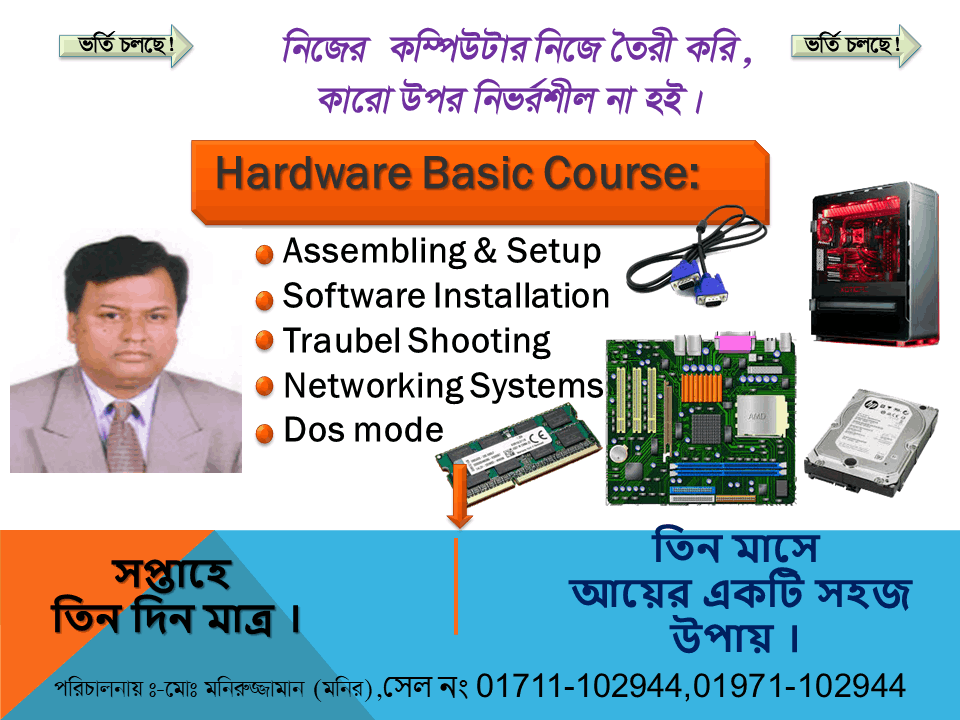
Hardware Course
Key Components of Hardware Training:
Hardware Fundamentals: Training typically begins with an introduction to the basic components of computer hardware, including the central processing unit (CPU), motherboard, memory, storage devices (e.g., hard drives and SSDs), and input/output devices (e.g., keyboards, mice, monitors).
Assembling and Disassembling: Participants learn how to assemble and disassemble computer systems. This includes mounting CPUs, attaching motherboards, connecting power supplies, and installing peripheral devices.
Operating Systems: Hardware training often covers the installation and configuration of operating systems, as well as driver management. Understanding how hardware interacts with software is crucial.
Maintenance and Upgrades: Individuals are taught how to maintain hardware by cleaning components, monitoring system performance, and upgrading various parts of the computer. This includes adding RAM, swapping out graphics cards, or replacing failed components.
Troubleshooting: Participants develop troubleshooting skills to identify and resolve hardware problems. This can involve diagnostic tools, error codes, and logical problem-solving techniques.
Networking: In modern IT environments, hardware training may also encompass network components, such as routers, switches, and network adapters. Understanding how hardware connects and communicates is essential.
Security Measures: Hardware training may include security measures to protect physical assets. This involves securing servers, using locks and access control systems, and implementing monitoring and alerting systems.
Relevance in Today's World:
Hardware training remains highly relevant in today's technology-driven world for several reasons:
Digital Transformation: As organizations undergo digital transformation, they require professionals who understand the physical infrastructure that underpins digital systems.
Cybersecurity: With the growing importance of cybersecurity, professionals need hardware training to secure physical assets against threats and vulnerabilities.
IoT and Edge Computing: As the Internet of Things (IoT) and edge computing expand, understanding the hardware that powers these technologies becomes critical.
Career Opportunities: Hardware expertise opens up various career opportunities in IT, ranging from computer technicians and network administrators to system architects and hardware engineers.
In conclusion, hardware training plays a crucial role in equipping individuals and professionals with the knowledge and skills needed to navigate the complex world of computer hardware. In an era of rapid technological advancements, this training remains a cornerstone of the IT industry, ensuring the efficient operation, security, and maintenance of hardware systems.
